

Handling, preparation & supplies
Resources
Reconstitution basics, storage information, measurement reference, and the supply links you need.
Reconstitution Basics
Simple steps. Accurate dosing. Clean results.
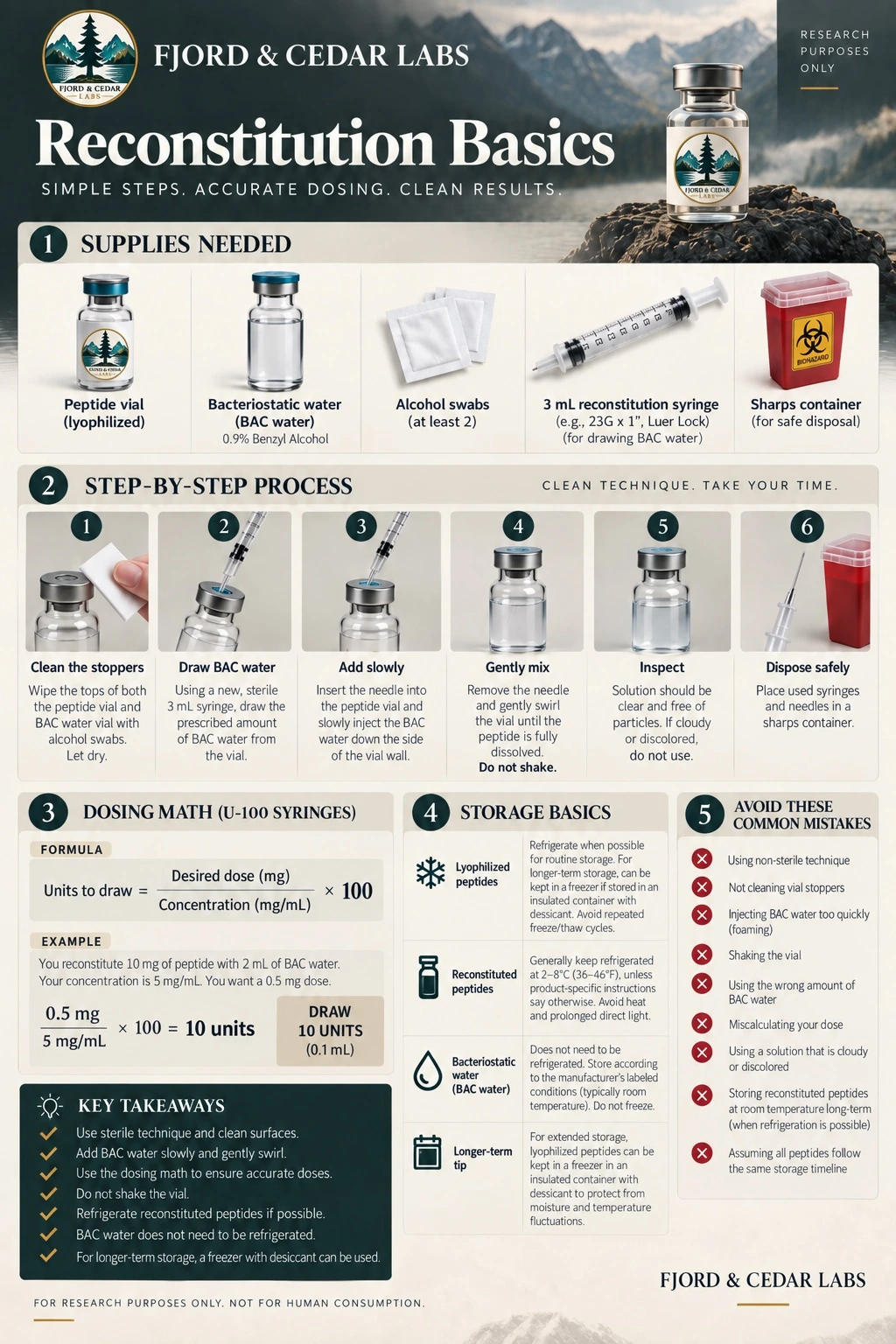
Preparation reference
Supplies and step-by-step process
Supplies needed
- Peptide vial (lyophilized)
- Bacteriostatic water (BAC water), 0.9% benzyl alcohol
- Alcohol swabs (at least two)
- 3 mL reconstitution syringe (e.g., 23G × 1 inch, Luer Lock), for drawing BAC water
- Sharps container for safe disposal
Clean technique. Take your time.
Clean the stoppers
Wipe the tops of both the peptide vial and BAC water vial with alcohol swabs. Let dry.
Draw BAC water
Using a new, sterile 3 mL syringe, draw the prescribed amount of BAC water from the vial.
Add slowly
Insert the needle into the peptide vial and slowly inject the BAC water down the side of the vial wall.
Gently mix
Remove the needle and gently swirl the vial until the peptide is fully dissolved. Do not shake.
Inspect
Solution should be clear and free of particles. If cloudy or discolored, do not use.
Dispose safely
Place used syringes and needles in a sharps container.
Storage basics
Protect your materials
Lyophilized peptides
Refrigerate when possible for routine storage. For longer-term storage, they can be kept in a freezer if stored in an insulated container with desiccant. Avoid repeated freeze/thaw cycles.
Reconstituted peptides
Generally keep refrigerated at 2–8°C (36–46°F), unless product-specific instructions say otherwise. Avoid heat and prolonged direct light.
Bacteriostatic water
Does not need to be refrigerated. Store according to the manufacturer’s labeled conditions, typically room temperature. Do not freeze.
Longer-term storage
For extended storage, lyophilized peptides can be kept in a freezer in an insulated container with desiccant to protect from moisture and temperature fluctuations.
Measurement reference
Concentration math
Keep vial content, diluent volume, concentration, and syringe markings distinct.
Concentration (mg/mL) = vial content (mg) ÷ diluent volume (mL)
Concentration example: 10 mg in 2 mL gives a concentration of 5 mg/mL.
U-100 measurement formula
Units to draw = desired dose (mg) ÷ concentration (mg/mL) × 100.
This is a unit-conversion formula, not a recommendation of an administration amount. No numerical administration example is included.
Avoid these common mistakes
- Using non-sterile technique.
- Not cleaning vial stoppers.
- Injecting BAC water too quickly and causing foaming.
- Shaking the vial.
- Using the wrong amount of BAC water.
- Miscalculating your dose.
- Using a solution that is cloudy or discolored.
- Storing reconstituted peptides at room temperature long-term when refrigeration is possible.
- Assuming all peptides follow the same storage timeline.
Recommended supplies
Supply links
- Injection Syringes
0.5 mL, 31G, 5/16 inch (8 mm) disposable syringes — 100 count.
View on Amazon ↗ - Reconstitution Syringes
3 mL Luer Lock syringes with 23G, 1 inch needles — 50 count.
View on Amazon ↗ - Alcohol Swabs
CURAD 70% isopropyl alcohol prep pads — 400 individually wrapped swabs.
View on Amazon ↗ - Sharps Container
Container for used needles and syringes. View the listing for current size and product details.
View on Amazon ↗
External Amazon links open in a new tab. Check the listing’s current specifications and availability before purchase.
Availability, pricing, or questions?
Reach Fjord & Cedar Labs directly by email or WhatsApp.