
Research use onlyNot for human consumption
Recovery & Regenerative
GHK-Cu
Copper Peptide · Regenerative Complex
GHK-Cu is a naturally occurring copper-binding peptide complex widely studied for its role in tissue repair, collagen support, skin quality, and overall regenerative signaling. In research settings, it is commonly discussed for skin health, wound support, hair-related applications, and broader restorative potential.
Trusted Quality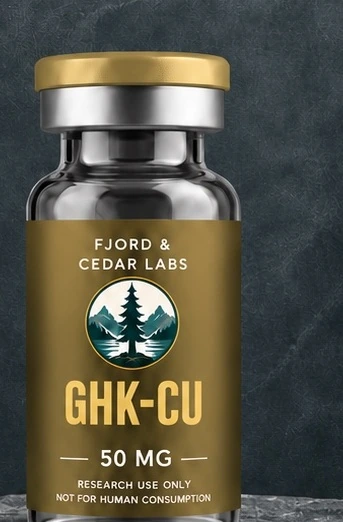
Quick Facts
- Naturally occurring copper peptide complex
- Commonly studied for skin and tissue support
- Associated with collagen and extracellular matrix activity
- Often discussed for hair and scalp applications
- May support wound-healing and recovery processes
- Broad regenerative interest in research settings
- Commonly used in topical and injectable research formats
Research Highlights
- Studied for collagen production and skin remodeling support
- Associated with tissue repair and wound-healing pathways
- Frequently discussed for skin elasticity and cosmetic recovery
- May support hair-related signaling in preclinical research
- Demonstrates broad regenerative and restorative interest
- Commonly explored for skin, scalp, and connective tissue support
How GHK-Cu Works
Collagen / Skin Support
Supports signaling associated with collagen synthesis, skin repair, and extracellular matrix balance in research models.
Tissue Repair / Recovery
Commonly discussed for wound support, restorative signaling, and connective tissue resilience.
Hair / Scalp Interest
Frequently explored in research tied to scalp environment, follicle support, and cosmetic recovery.
Protocol Tips
- Use consistently for best research continuity
- Can be explored in skin, hair, or tissue-support contexts
- Pair with overall recovery-focused strategies
- Maintain appropriate storage and handling practices
- Monitor individual response and application goals
Cycle Guidance
- Typical cycle length: 4–12 weeks
- Reassess goals and response before continuation
- May be repeated depending on the research objective
- Often used as part of a broader restorative strategy
Ask about available vial sizes and current pricing.